1. The Common Pricing Fallacy in Online Retail
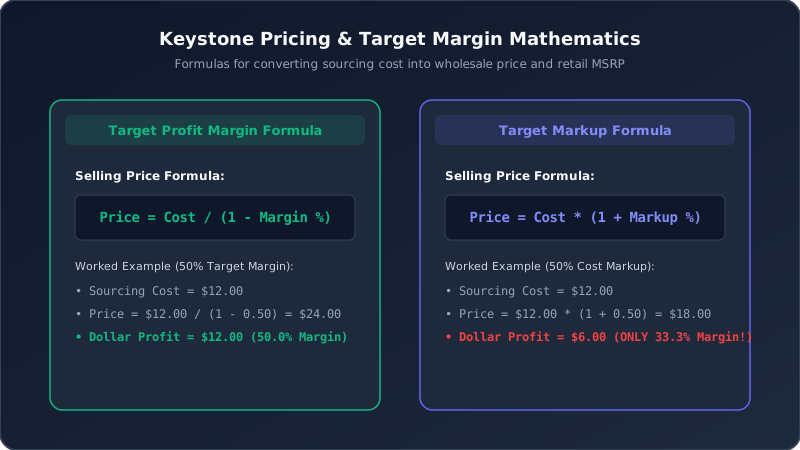
One of the most frequent financial mistakes made by online store owners is confusing Gross Profit Margin with Cost Markup. While both metrics measure profitability, pricing products using markup percentages when targeting gross margin goals leads to underpriced items, unabsorbed ad costs, and net operating losses.
2. Mathematical Definitions & Formulas
Understanding the exact formulas distinguishes successful e-commerce brands from struggling stores:
- Gross Margin Percentage: Measures the percentage of total sales revenue retained after subtracting COGS. Formula:
Margin % = ((Price - Cost) / Price) * 100 - Cost Markup Percentage: Measures the percentage added onto item sourcing cost to arrive at selling price. Formula:
Markup % = ((Price - Cost) / Cost) * 100
3. Margin vs. Markup Conversion Table
Use this reference table to quickly convert desired profit margins into required cost markups when pricing new inventory:
| Target Gross Margin % | Required Cost Markup % | Price Multiplier Formula |
|---|---|---|
| 20.0% Gross Margin | 25.0% Markup | Cost / 0.80 |
| 33.3% Gross Margin | 50.0% Markup | Cost / 0.667 |
| 50.0% Keystone Margin | 100.0% Markup | Cost / 0.50 (Cost x 2) |
| 60.0% Gross Margin | 150.0% Markup | Cost / 0.40 |
| 75.0% Gross Margin | 300.0% Markup | Cost / 0.25 (Cost x 4) |
4. The Keystone Pricing Model Explained
In retail e-commerce, Keystone Pricing refers to doubling your item cost (a 100% markup). Doubling a $15 product cost gives a $30 selling price, yielding a 50% Gross Profit Margin ($15 gross profit / $30 price = 50%).
For DTC brands and marketplace sellers running paid ad campaigns (PPC), keystone pricing provides necessary gross margin buffer to absorb customer acquisition costs (CAC) and marketplace commission fees.
5. How to Calculate Target Selling Price Step-by-Step
To calculate selling price for a target 45% gross margin on a product with $11 sourcing cost:
- Identify Target Margin: 45% (0.45)
- Calculate Cost Complement: 1 - 0.45 = 0.55
- Divide Sourcing Cost by Complement: $11 / 0.55 = $20.00 Retail MSRP
6. Generate Customized Wholesale Pricing Tables
Build customized price ladders across 15 target margin tiers using our interactive Profit Margin Calculator & Wholesale Matrix.