1. Overview of Amazon FBA Fee Updates in 2026
Operating a profitable Amazon FBA (Fulfillment by Amazon) business requires continuous accounting vigilance. In 2026, Amazon has refined its logistics pricing model to incentivize inventory decentralization and prevent warehouse overstocking. Sellers who understand how inbound placement fees, fulfillment size tiers, and referral percentages interact can preserve net margins upwards of 30%.
2. Inbound Placement Service Fees: Minimal vs. Distributed Placement
One of the most impactful fee adjustments introduced by Amazon logistics is the Inbound Placement Service Fee. Amazon provides sellers two primary options when creating inbound shipment plans:
- Minimal Inbound Splits (Single Destination): If you ship your full cargo shipment to a single regional facility, Amazon handles internal cross-docking and charges an inbound placement fee ranging from $0.21 to $0.68 per unit depending on weight and package size tier.
- Partial or Distributed Placement (Multi-Location Splits): By splitting your inbound shipment across 4 or more Amazon-designated fulfillment centers nationwide, the placement surcharge is reduced to $0.00 per unit.
3. Low-Inventory-Level Surcharges & Stock Management
To avoid regional stockouts during high-demand promotional periods, Amazon enforces a Low-Inventory-Level Surcharge. This fee applies exclusively to FBA products whose historical inventory levels fall below 28 days of supply relative to trailing 30-day and 90-day sales velocity.
Maintaining a healthy stock buffer of 35 to 60 days of inventory prevents this surcharge while protecting your Buy Box percentage and keyword ranking momentum.
4. 2026 Amazon Referral Fee Rate Schedule
Amazon referral fees are charged as a percentage of the total sales price (including item price and any customer-paid gift wrap charges). Below is the official 2026 category rate table:
| Product Category | Referral Fee Percentage | Minimum Referral Fee |
|---|---|---|
| Home, Kitchen, Toys, Outdoor | 15.0% | $0.30 |
| Consumer Electronics & Computers | 8.0% | $0.30 |
| Apparel & Accessories (< $15) | 10.0% | $0.30 |
| Apparel & Accessories (≥ $15) | 17.0% | $0.30 |
| Beauty & Personal Care (< $10) | 8.0% | $0.30 |
| Beauty & Personal Care (≥ $10) | 15.0% | $0.30 |
5. FBA Pick & Pack Fulfillment Size Tiers
Amazon calculates fulfillment fees based on shipping weight and unit dimensions. Shifting a product from Large Standard to Small Standard by redesigning custom box packaging can save significant capital per unit shipped:
- Small Standard (< 16 oz, max 15" x 12" x 0.75"): $3.40 per unit.
- Large Standard (1 to 2 lbs, max 18" x 14" x 8"): $5.40 per unit.
- Large Standard (2 to 3 lbs): $6.10 per unit.
- Small Oversize (< 70 lbs): $10.20 + $0.42/lb over 1 lb.
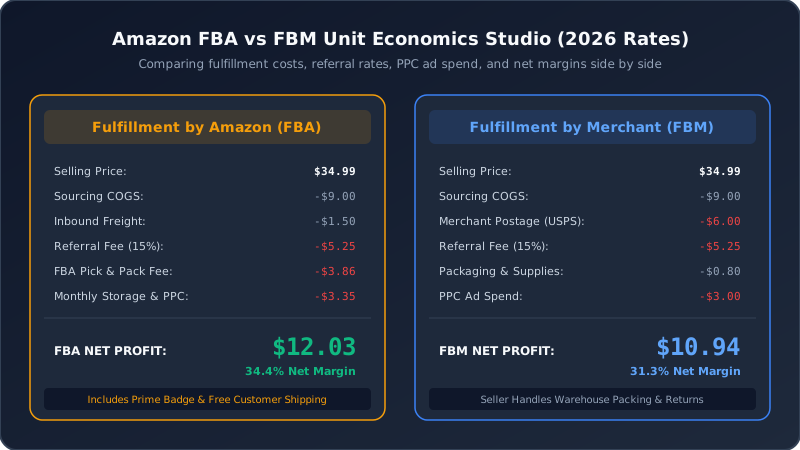
6. Worked Calculation: Calculating Real Net Margin on a $35 Home Good
Consider a Home Decor item selling for $35.00 with a 1.5 lb Large Standard size tier, $8.00 sourcing cost, and $3.00 PPC ad spend:
- Selling Price: $35.00
- Sourcing COGS: -$8.00
- Amazon Referral Fee (15% of $35): -$5.25
- FBA Fulfillment Pick & Pack: -$5.40
- PPC Ad Spend per Order: -$3.00
- Inbound Postage & Packaging: -$1.20
- Net Profit per Unit: $12.15 (34.7% Net Profit Margin)
7. Actionable Profit Optimization Strategies
To maximize your Amazon FBA profitability in 2026:
- Audit Dimensional Weight: Shave off 0.5 inches of plastic polybag margin to fit into lower size tiers.
- Bundle Multi-Packs: Selling 2-packs increases Average Order Value (AOV) while paying the fixed FBA pick & pack fee once.
- Use SellerKitHub's Free Tools: Test your exact product weight, dimensions, and referral tiers using our Amazon FBA Fee Calculator.